
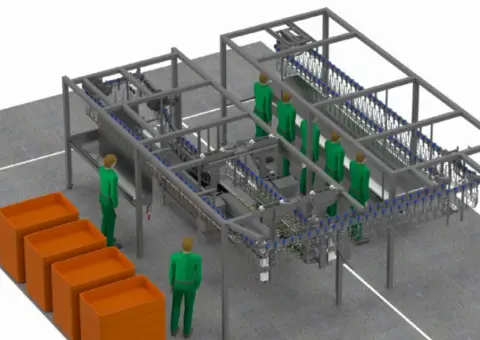
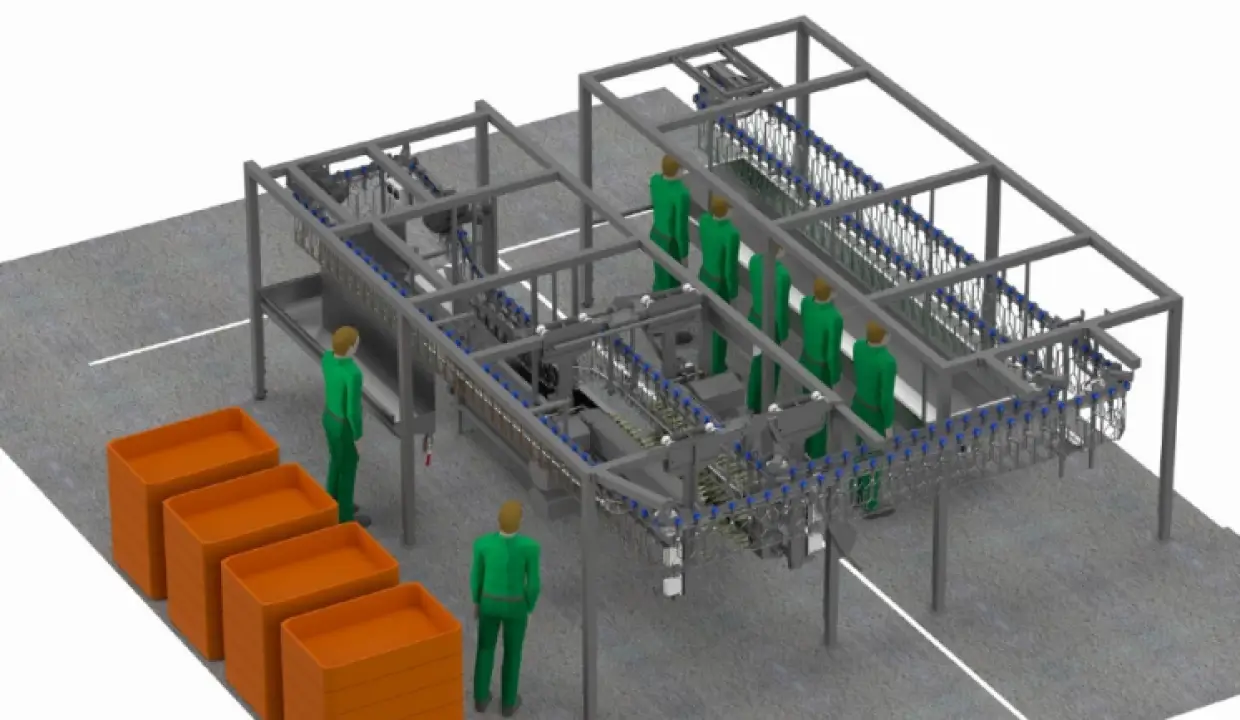
Rabbit slaughter line capacity: up to 1,000 heads per shift
1,500 ₴
Meat products
3 weeks
Україна
01025 - Трьохсвятительська вулиця 4
360 views
Published 3 weeks ago by Vlad
1,500 ₴
In Meat products category
Трьохсвятительська вулиця 4, 01025, Україна
Get directions →
360 item views
• Slaughter zone (dirty shop) – where rabbits are stunned by a throat nick and bled;• Processing zone (clean shop) with a refrigerator for product storage.
Capacity: 1000 heads per shift (120 heads per hour)
Functionality: Anatomical cutting
Vacuum packaging (GMS possible)
Packaging on stretch tape onto a tray
Cleaning and freezing of offal
The rabbit slaughter and processing complex includes a meat processing area and a primary gut cleaning area.
Preparation of rabbits for slaughter
Rabbits are slaughtered when the animal reaches 4–4.5 months of age. Another important indicator is the level of fattening. If an animal does not meet certain indicators, it is sent for intensive fattening.
But the most important criterion for determining the time of slaughter is the molting period, since a quality pelt can only be obtained after the molting stage is completed.
The duration of the first molt is 2–2.5 months; it begins after the animal reaches 1 month and continues until the age of 3–3.5 months. Then there is a break and about 2 weeks later the second molting period begins, which lasts until the age of 5–5.5 months.
When molting is over, slaughter can begin. Rabbits should not be fed for 12 hours before slaughter so that the animal’s intestines are completely emptied. Only water may be given; then the rabbit meat will not have foreign unpleasant odors.
Methods and techniques of rabbit slaughter
There are many methods of slaughtering rabbits for meat, but the most common are:
Bloodless method of rabbit slaughter
The most frequently used method. It is carried out as follows: the rabbit is taken out of the cage, held by the hind legs, and when the animal stops struggling a wooden stick is used to strike the occipital area (behind the ears). It is better to choose a stick with a square cross-section so as not to damage the skin. A weapon with a round cross-section is recommended to be additionally wrapped with fabric or fitted with a rubber pad. Blood after the blow flows from the nose and ears.
French method
The rabbit is taken by the ears and hind legs, lifted by the legs up; when the animal calms down, it is sharply jerked, the spinal cord ruptures, and instant death occurs. Bleeding is also carried out through the nose and ears.
Throat cutting
For stronger bleeding, the animal’s throat is cut; the heart muscle continues to contract for a few minutes and ejects blood, thus the meat comes out lighter, but the pelt loses its marketable appearance due to the cut, and the fur becomes smeared with blood, which significantly impairs its quality.
Slaughter by electric current
This method is mainly used in large slaughterhouses. The animal’s head is placed into a special device where voltage is applied. After the electric shock, heartbeat remains, which ensures good bleeding of the carcass and high meat quality.
Of all the methods presented, the bloodless ones are the most humane. It is believed that throat cutting causes much greater suffering to the animal than the others.
The proposed solution includes:
• Reception vestibule for rabbits
• Rabbit slaughter line with a capacity of up to 120 heads/hour
• Room for mucus processing and salting of pelts
• Room for anatomical cutting and packaging
• Cold storage chambers
• Veterinarian’s office
• Changing room for 6 people
The slaughter and processing complex is designed based on the requirement to minimize occupied land area. However, all requirements for the organization of workplaces in meat industry enterprises and compliance with the correctness of technological processes were taken into account.
In order to minimize the occupied land area, production premises are combined by zones and grouped in volume.
Production premises are arranged so that all dirty production – ndash; slaughter and its accompanying processes and technological premises are located symmetrically, all meat processing and semi-finished product production rooms, including long-term storage refrigeration chambers, are located on the other side.
The complex is a finished solution and does not have the possibility to increase productivity.
Published on 2026/09/13
Description
• Slaughter zone (dirty shop) – where rabbits are stunned by a throat nick and bled;• Processing zone (clean shop) with a refrigerator for product storage.
Capacity: 1000 heads per shift (120 heads per hour)
Functionality: Anatomical cutting
Vacuum packaging (GMS possible)
Packaging on stretch tape onto a tray
Cleaning and freezing of offal
The rabbit slaughter and processing complex includes a meat processing area and a primary gut cleaning area.
Preparation of rabbits for slaughter
Rabbits are slaughtered when the animal reaches 4–4.5 months of age. Another important indicator is the level of fattening. If an animal does not meet certain indicators, it is sent for intensive fattening.
But the most important criterion for determining the time of slaughter is the molting period, since a quality pelt can only be obtained after the molting stage is completed.
The duration of the first molt is 2–2.5 months; it begins after the animal reaches 1 month and continues until the age of 3–3.5 months. Then there is a break and about 2 weeks later the second molting period begins, which lasts until the age of 5–5.5 months.
When molting is over, slaughter can begin. Rabbits should not be fed for 12 hours before slaughter so that the animal’s intestines are completely emptied. Only water may be given; then the rabbit meat will not have foreign unpleasant odors.
Methods and techniques of rabbit slaughter
There are many methods of slaughtering rabbits for meat, but the most common are:
Bloodless method of rabbit slaughter
The most frequently used method. It is carried out as follows: the rabbit is taken out of the cage, held by the hind legs, and when the animal stops struggling a wooden stick is used to strike the occipital area (behind the ears). It is better to choose a stick with a square cross-section so as not to damage the skin. A weapon with a round cross-section is recommended to be additionally wrapped with fabric or fitted with a rubber pad. Blood after the blow flows from the nose and ears.
French method
The rabbit is taken by the ears and hind legs, lifted by the legs up; when the animal calms down, it is sharply jerked, the spinal cord ruptures, and instant death occurs. Bleeding is also carried out through the nose and ears.
Throat cutting
For stronger bleeding, the animal’s throat is cut; the heart muscle continues to contract for a few minutes and ejects blood, thus the meat comes out lighter, but the pelt loses its marketable appearance due to the cut, and the fur becomes smeared with blood, which significantly impairs its quality.
Slaughter by electric current
This method is mainly used in large slaughterhouses. The animal’s head is placed into a special device where voltage is applied. After the electric shock, heartbeat remains, which ensures good bleeding of the carcass and high meat quality.
Of all the methods presented, the bloodless ones are the most humane. It is believed that throat cutting causes much greater suffering to the animal than the others.
The proposed solution includes:
• Reception vestibule for rabbits
• Rabbit slaughter line with a capacity of up to 120 heads/hour
• Room for mucus processing and salting of pelts
• Room for anatomical cutting and packaging
• Cold storage chambers
• Veterinarian’s office
• Changing room for 6 people
The slaughter and processing complex is designed based on the requirement to minimize occupied land area. However, all requirements for the organization of workplaces in meat industry enterprises and compliance with the correctness of technological processes were taken into account.
In order to minimize the occupied land area, production premises are combined by zones and grouped in volume.
Production premises are arranged so that all dirty production – ndash; slaughter and its accompanying processes and technological premises are located symmetrically, all meat processing and semi-finished product production rooms, including long-term storage refrigeration chambers, are located on the other side.
The complex is a finished solution and does not have the possibility to increase productivity.
Attributes
Related listings in your area
How far is it?
Show listings in my area
Show only listings that are
km distanced
Show listings
Contact the seller
 User is offline
Vlad
Verified user
- 11 active listings
- Peronal seller
- Registered for 10 months
- Last online 6 days ago
- Львівська область, Україна
Related items
Vlad
Thursday 09:21

Verified user
Shrink machines with automatic loading and unloading
1,500 ₴
Shrink machines with automatic loading and unloading
Львів, Україна
Shrink machine with automatic loading, immersion/lifting and product unloading. Ability to synchronize with vacuum sealers EVA-9-11, EVC-26, EVDA-20.Automatic shrink machine with immersion of the product in hot water - an ideal complement to vacuum packaging equipment. After this operation, product shelf life is increased and its appearance is improved.Autom...
Thursday
Meat products
79000 - вулиця Юліуша Словацького 3
1,500 ₴
Vlad
1 week

Verified user
HAND-HELD PNEUMATIC SKINNING MACHINE PSIHOGIOS (GREECE)
1,500 ₴
HAND-HELD PNEUMATIC SKINNING MACHINE PSIHOGIOS (GREECE)
Львів, Україна
Hand-held pneumatic skinning machine PSIHOGIOS (Greece). Removes skin and fat with adjustable depth. Ideally suited for removing pig bristle roots and part of the hide, cuts in strips, etc. Low speed and high torque. Compact, lightweight, ergonomic design, non-slip handle with a soft throttle lever for operator comfort. Plastic cover on the housing absorbs t...
1 week
Delivery / pickup: Pickup, Nova...
Meat products
79000 - площа Адама Міцкевича
1,500 ₴
Vlad
1 week

Verified user
Knife sharpening device for processing knives
1,500 ₴
Knife sharpening device for processing knives
Львів, Україна
Місто Lviv Стан New Product description• Ideal blade quality with easy and convenient use of the sharpening device• Increased service life of the cutting edge• Adjustable blade angle to the user's needsTechnical descriptionThe W7C sharpening device for meat knives is easy to use and at the same time very powerful. A three-stage sharpening process is achieved...
1 week
Meat products
79020 - Варшавська вулиця 179
1,500 ₴
Vlad
2 weeks
Verified user
Poultry processing line
1,500 ₴
Poultry processing line
Львів, Україна
Nearly full automation (only manual hanging of the bird is required);Compactness (length – 6 m, width – 1.4 m). The dimensions of the line allow the equipment to be placed at poultry processing and slaughter enterprises with small production areas.Cutting modules are fully automated. Each part has a separate program, it can be replaced or temporarily stopped...
2 weeks
Meat products
1,500 ₴
Vlad
3 weeks

Verified user
Refrigerator and freezer hinged doors
1,500 ₴
Refrigerator and freezer hinged doors
Львів, Україна
Standard option:- Matte finish of the door leaf— Filling with polyurethane foam— Slanted door hinges- Rubber/silicone sealing- Sealing directly to the floor (no threshold)— Self-heating heater for freezers- PVC curtain for monorail hoistType Door leaf Thickness Frame Thickness Number of door leavesZK-1 thickness 6 thickness 4 (up to 0°C) 1ZK-2 thickness 6 th...
3 weeks
Meat products
79000
1,500 ₴
Vlad
3 weeks
Verified user
Pig and cattle slaughter line
1,500 ₴
Pig and cattle slaughter line
Львів, Україна
Pig slaughter linesWe provide our customers with complete systems or their partial components. depending on individual wishes. The capacity of the installations is calculated for slaughter of up to 240 pigs per hour.• preslaughter bases that comply with animal welfare society standards• drives• electric stunning in a box• horizontal bleeding• vertical bleedi...
3 weeks
Meat products
1,500 ₴
Vlad
3 weeks
Verified user
Drum hide puller Junior with platforms (Poland) - new and used
1,500 ₴
Drum hide puller Junior with platforms (Poland) - new and used
Львів, Україна
The entire hide-pulling machine with platforms is fixed to the floor. The hide puller operates by winding the hide onto a drum that has its own drive. Proper securing of the cattle's front limbs and the angle of the chain placement allow the hide to be removed without tearing it and without fracturing the spine. Two people are required for correct hide remov...
3 weeks
Meat products
1,500 ₴
Vlad
3 weeks
Verified user
Sternum Saw EFA 67 LONGLIFE, 42 V
1,500 ₴
Sternum Saw EFA 67 LONGLIFE, 42 V
Львів, Україна
Fully enclosed, waterproof housing. In this model increased power, reduced weight, decreased vibration. The saw is easy to maintain. All external elements of the saw are made of materials resistant to corrosion.Fully enclosed waterproof housing.Advantages: increased power; reduced weight of the saw; reduced vibration; ease of maintenance; all external e...
3 weeks
Meat products
79000 - Трьохсвятительська вулиця 4
1,500 ₴
Vlad
3 weeks

Verified user
Scalding machine (scraper) for pigs
1,500 ₴
Scalding machine (scraper) for pigs
Україна
Two-shaft scalding machine is designed for cleaning pig carcasses from bristles. The machine is used for removing hair from the skin of pigs, from the entire surface of the carcass, including its heaviest parts. A 12 kW heater heats special thermal oil inside the tank at the bottom of the machine, which in turn heats the water in the scalding machine to 62...
3 weeks
Meat products
01025 - Трьохсвятительська вулиця 4
1,500 ₴
Vlad
3 weeks
Verified user
Machine for cleaning pigs' and cattle hooves
1,500 ₴
Machine for cleaning pigs' and cattle hooves
Україна
The purpose of the apparatus is to clean the hooves of pigs and cattle from bristles. The already severed legs are loaded through the top doors.The legs rotate on the chamber disk and are pressed to the side wall by centrifugal force. During rotation, water at a temperature of 62°C is poured into the machine chamber and caustic soda is added.To avoid motor o...
3 weeks
Meat products
01025 - Трьохсвятительська вулиця 4
1,500 ₴
 Олена Антоненко
1 month
Олена Антоненко
1 month

Verified user
pork carcasses, half-carcasses, quarters
143 ₴
pork carcasses, half-carcasses, quarters
Олександрія, Україна
I offer pork of a meat-typeSmoked with straw!Carcass, half carcass - 143 UAH/kg. Without trotters and hocks 165 UAH/kgFront quarter - 143 UAH/kgPieces 10–13 kg 143 UAH/kgHind quarter 145 UAH/kgHam 145 UAH/kgPiece middle 5–15 kg 165 UAH/kgHead, liver - 50 UAH/kgDelivery within the city of Oleksandriia is freeOrders are accepted on an ongoing basis at the numb...
1 month
Meat products
28000
143 ₴
 Welcome!


